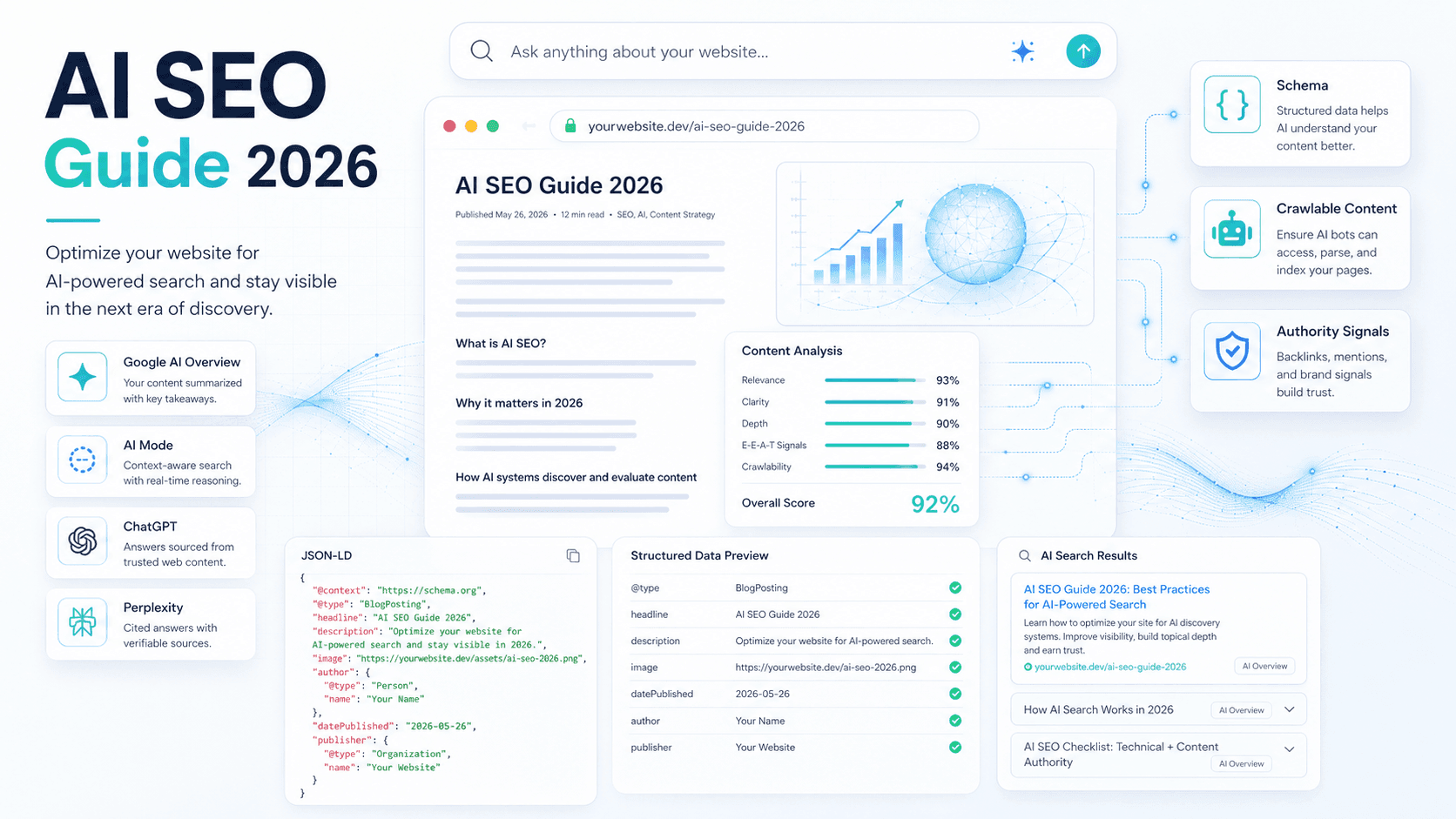
AI SEO Guide 2026: How to Optimize Your Website for AI Search
A practical developer-friendly guide to AI SEO in 2026. Learn how to make your website easier for Google AI Overviews, AI Mode, ChatGPT, Perplexity and other AI-powered search systems to understand, trust and reference. This tutorial covers content structure, technical SEO, structured data, crawlability, authority signals, robots.txt, JSON-LD examples and measurement tips.
Search is changing very fast.
Earlier, SEO was mostly about ranking on Google search result pages. In 2026, users are also discovering websites through AI-powered answers, Google AI Overviews, Google AI Mode, ChatGPT, Perplexity and other answer engines.
This does not mean traditional SEO is dead. It means your content must be easier for both humans and AI systems to understand, trust, cite and recommend.
In this guide, we will understand AI SEO from a developer and content creator point of view.
We will cover:
- What AI SEO means
- How Google AI Overviews and AI Mode work
- Difference between SEO, AEO and GEO
- How to structure content for AI search
- Technical SEO checklist for AI visibility
- Structured data examples
- Robots.txt examples for AI crawlers
- Next.js JSON-LD example
- How to measure AI SEO performance
- Final AI SEO checklist for 2026
What Is AI SEO?
AI SEO is the process of optimizing your website so it can be discovered, understood and referenced by AI-powered search systems.
These systems may include:
- Google AI Overviews
- Google AI Mode
- ChatGPT Search
- Perplexity
- Bing Copilot
- AI browser agents
- Other answer engines and AI assistants
Traditional SEO focuses on ranking pages in search results.
AI SEO focuses on making your content useful enough to be selected, summarized, cited or recommended by AI-powered search experiences.
But the foundation is still the same:
- Helpful content
- Crawlable pages
- Clear structure
- Fast page experience
- Good internal linking
- Trusted sources
- Strong topical authority
- Clean technical SEO
AI SEO is not about tricking AI systems. It is about making your website easier to understand and more valuable than generic content.
SEO vs AEO vs GEO
You may hear three terms:
| Term | Full Form | Meaning |
|---|---|---|
| SEO | Search Engine Optimization | Optimizing for search engines |
| AEO | Answer Engine Optimization | Optimizing for direct answers |
| GEO | Generative Engine Optimization | Optimizing for generative AI search systems |
In practical terms, all three are connected.
For most websites, you do not need a completely separate strategy for each term. You need strong SEO fundamentals and content that is clear, original, helpful and easy to extract.
A good AI SEO article should:
- Answer the main question clearly
- Explain the topic deeply
- Use proper headings
- Include examples
- Include comparison tables
- Add original experience
- Use schema where useful
- Link to related pages
- Stay technically crawlable
- Avoid thin AI-generated content
How Google AI Overviews and AI Mode Work
Google AI Overviews and AI Mode are generative search experiences. They can summarize information and show supporting links to users.
Google’s AI systems can use techniques like retrieval-augmented generation and query fan-out.
In simple words:
- User asks a question.
- Google may run multiple related searches behind the scenes.
- It collects relevant information from indexed pages.
- It generates an answer.
- It shows supporting links where users can explore more.
For example, if someone searches:
how to speed up a next.js websiteThe system may also look for related subtopics like:
next.js image optimization
reduce javascript bundle next.js
core web vitals next.js
next.js font optimization
server components performance
That means your article can appear for more than the exact keyword you targeted.
This is why modern SEO should not focus only on one keyword. It should cover the complete topic properly.
The Most Important AI SEO Rule
The most important rule is simple:
Write content that gives users something they cannot get from a generic AI answer.
Generic content is easy to replace. Original content is harder to replace.
Bad content idea:
10 SEO tips for better rankingsBetter content idea:
How I improved a Next.js blog's Core Web Vitals and organic traffic using image optimization, structured data and internal linkingThe second article has:
- Real experience
- Specific technology
- Specific outcome
- Practical examples
- More trust
- More originality
AI systems and search engines are becoming better at identifying content that only repeats what already exists.
So avoid writing articles that only summarize common knowledge.
What Type of Content Works Better for AI Search?
AI search systems usually prefer content that is clear, specific and useful.
Good content types include:
- Step-by-step tutorials
- Practical guides
- Original case studies
- Comparison articles
- Troubleshooting guides
- Code examples
- Checklists
- Definitions with examples
- Product or tool evaluations
- Real experience-based posts
- Updated technical documentation
Poor content types include:
- Thin listicles
- Generic AI-written articles
- Pages created only for long-tail keywords
- Rewritten versions of competitor articles
- Articles with no examples
- Articles with no author experience
- Content that looks helpful but says nothing new
How to Structure an Article for AI SEO
A good AI SEO article should be easy to scan, easy to parse and easy to quote.
Use this structure:
# Main Article Title

Short introduction explaining the problem.

## What Is [Topic]?

Clear definition.

## Why It Matters

Explain the business or technical impact.

## How It Works

Explain the process.

## Step-by-Step Implementation

Show practical steps.

## Code Example

Add real implementation.

## Common Mistakes

Explain what to avoid.

## Checklist

Give a practical summary.

## Final Thoughts

Wrap up with clear action points.
This structure helps both users and search systems understand the purpose of every section.
Start With a Direct Answer
A good article should answer the main question early.
Bad intro:
In the modern digital landscape, businesses are increasingly looking for new ways to enhance their visibility and improve their long-term growth opportunities through innovative search technologies.Better intro:
AI SEO is the process of making your website easier for AI-powered search systems like Google AI Overviews, AI Mode, ChatGPT and Perplexity to understand, trust and reference.The second version is clear, direct and useful.
Use Definitions
AI systems often need clear definitions.
Example:
## What Is Generative Engine Optimization?

Generative Engine Optimization, or GEO, is the process of improving your content so generative AI search systems can understand, summarize and reference it accurately.
Definitions help your article appear for informational queries.
Use Tables
Tables are very useful for AI search because they organize information clearly.
Example:
| SEO Area       | Traditional SEO         | AI SEO                                      |
| -------------- | ----------------------- | ------------------------------------------- |
| Goal           | Rank in search results  | Be selected, cited or summarized            |
| Content Style  | Keyword-focused         | Answer-focused and entity-focused           |
| Measurement    | Clicks and rankings     | Clicks, mentions, citations and visibility  |
| Technical Need | Crawlable and indexable | Crawlable, indexable and easy to understand |
Tables are especially useful for:
- Comparisons
- Checklists
- Pricing
- Pros and cons
- Feature differences
- Technical requirements
- Step-by-step summaries
Use FAQ Sections
FAQ sections help answer specific questions directly.
Example:
## FAQs

### Is AI SEO different from normal SEO?

AI SEO is not completely separate from normal SEO. It builds on traditional SEO but focuses more on clear answers, original information, entity clarity, structured content and AI search visibility.

### Do I need special schema for AI Overviews?

No special AI-specific schema is required. However, structured data can still help search engines understand your content and can make your page eligible for rich results.

### Should I create an llms.txt file?

You do not need an llms.txt file for Google Search visibility. Some AI tools may use similar files in the future, but it is not a replacement for crawlable HTML, structured content and strong SEO.
Do not add fake FAQs only for SEO. Add questions that users genuinely ask.
Add Original Experience
This is one of the biggest differences between weak content and strong content.
Generic:
Page speed is important for SEO and user experience.Better:
When I optimized a blog article page, the biggest improvement came from fixing the hero image. The image was lazy-loaded, oversized and missing width and height. After converting it to WebP, adding dimensions and loading it eagerly, the LCP improved significantly.Original experience makes your content more trustworthy.
If you are writing technical content, include:
- What you tested
- What failed
- What worked
- What trade-off you made
- Which tool you used
- Which version you used
- What result you observed
Make Your Content Entity-Friendly
AI search systems need to understand entities.
Entities can be:
- People
- Companies
- Products
- Frameworks
- Libraries
- Concepts
- Places
- Tools
- Technologies
Example entities in an AI SEO article:
Google AI Overviews
Google AI Mode
ChatGPT
Perplexity
Search Console
JSON-LD
Schema.org
Core Web Vitals
Next.js
robots.txt
Do not stuff entities randomly. Use them naturally in useful context.
Bad:
AI SEO Google AI Overview ChatGPT Perplexity JSON-LD schema SEO ranking best tips guide.Good:
For Google AI Overviews and AI Mode, your page must still follow normal Search requirements. That means the page should be crawlable, indexable and eligible to show a snippet.Technical SEO Checklist for AI Visibility
AI SEO still depends heavily on technical SEO.
Your content should be:
- Crawlable
- Indexable
- Fast
- Mobile-friendly
- Internally linked
- Canonicalized
- Available in clean HTML
- Not blocked by robots.txt
- Not hidden behind login
- Not fully dependent on client-side rendering
- Supported with structured data where useful
Basic SEO Metadata Example
For a blog article, you should have clean metadata.
// app/articles/[slug]/page.tsx
import type { Metadata } from "next";

export async function generateMetadata(): Promise<Metadata> {
  return {
    title: "AI SEO Guide 2026: How to Optimize Your Website for AI Search",
    description:
      "Learn how AI SEO works in 2026 and how to optimize your website for Google AI Overviews, AI Mode, ChatGPT, Perplexity and other AI-powered search experiences.",
    alternates: {
      canonical:
        "https://www.example.com/articles/ai-seo-generative-engine-optimization-guide-2026",
    },
    openGraph: {
      title: "AI SEO Guide 2026",
      description:
        "A practical developer-friendly guide to AI SEO, structured data, crawlability and AI search visibility.",
      url: "https://www.example.com/articles/ai-seo-generative-engine-optimization-guide-2026",
      type: "article",
      images: [
        {
          url: "https://www.example.com/images/articles/ai-seo-generative-engine-optimization-guide-2026.webp",
          width: 1600,
          height: 900,
          alt: "AI SEO dashboard showing Google AI Overviews, ChatGPT, Perplexity, schema and crawlable content signals",
        },
      ],
    },
    twitter: {
      card: "summary_large_image",
      title: "AI SEO Guide 2026",
      description: "Learn how to optimize your website for AI-powered search experiences.",
    },
  };
}
Add Article Schema with JSON-LD
Structured data is not a magic ranking hack. But it helps search engines understand your page and can make your content eligible for rich results.
For articles, you can add Article or BlogPosting schema.
export function ArticleJsonLd() {
  const jsonLd = {
    "@context": "https://schema.org",
    "@type": "BlogPosting",
    headline: "AI SEO Guide 2026: How to Optimize Your Website for AI Search",
    description:
      "Learn how AI SEO works in 2026 and how to optimize your website for Google AI Overviews, AI Mode, ChatGPT, Perplexity and other AI-powered search experiences.",
    image:
      "https://www.example.com/images/articles/ai-seo-generative-engine-optimization-guide-2026.webp",
    datePublished: "2026-07-18",
    dateModified: "2026-07-18",
    author: {
      "@type": "Person",
      name: "Vishal",
      url: "https://www.example.com",
    },
    publisher: {
      "@type": "Organization",
      name: "Vishal Blog",
      logo: {
        "@type": "ImageObject",
        url: "https://www.example.com/logo.png",
      },
    },
    mainEntityOfPage: {
      "@type": "WebPage",
      "@id": "https://www.example.com/articles/ai-seo-generative-engine-optimization-guide-2026",
    },
  };

  return (
    <script
      type="application/ld+json"
      dangerouslySetInnerHTML={{
        __html: JSON.stringify(jsonLd).replace(/</g, "\\u003c"),
      }}
    />
  );
}
Then include it on your article page:
export default function ArticlePage() {
  return (
    <>
      <ArticleJsonLd />
      <article>
        <h1>AI SEO Guide 2026: How to Optimize Your Website for AI Search</h1>
        {/* Article content */}
      </article>
    </>
  );
}
Add Breadcrumb Schema
Breadcrumbs help search engines understand where the page fits inside your website.
export function BreadcrumbJsonLd() {
  const jsonLd = {
    "@context": "https://schema.org",
    "@type": "BreadcrumbList",
    itemListElement: [
      {
        "@type": "ListItem",
        position: 1,
        name: "Home",
        item: "https://www.example.com",
      },
      {
        "@type": "ListItem",
        position: 2,
        name: "Articles",
        item: "https://www.example.com/articles",
      },
      {
        "@type": "ListItem",
        position: 3,
        name: "AI SEO Guide 2026",
        item: "https://www.example.com/articles/ai-seo-generative-engine-optimization-guide-2026",
      },
    ],
  };

  return (
    <script
      type="application/ld+json"
      dangerouslySetInnerHTML={{
        __html: JSON.stringify(jsonLd).replace(/</g, "\\u003c"),
      }}
    />
  );
}
Add FAQ Schema Carefully
If your article has a real FAQ section, you can add FAQ schema.
export function FaqJsonLd() {
  const jsonLd = {
    "@context": "https://schema.org",
    "@type": "FAQPage",
    mainEntity: [
      {
        "@type": "Question",
        name: "Is AI SEO different from normal SEO?",
        acceptedAnswer: {
          "@type": "Answer",
          text: "AI SEO builds on traditional SEO but focuses more on clear answers, original information, structured content and visibility in AI-powered search experiences.",
        },
      },
      {
        "@type": "Question",
        name: "Do I need special schema for AI Overviews?",
        acceptedAnswer: {
          "@type": "Answer",
          text: "No special AI-specific schema is required for AI Overviews. However, structured data can still help search engines understand your content and may make pages eligible for rich results.",
        },
      },
    ],
  };

  return (
    <script
      type="application/ld+json"
      dangerouslySetInnerHTML={{
        __html: JSON.stringify(jsonLd).replace(/</g, "\\u003c"),
      }}
    />
  );
}
Important: only mark up FAQ content that is visible on the page.
Make JavaScript Content Crawlable
If your website uses React, Next.js or another JavaScript framework, make sure important article content is available in the rendered HTML.
Avoid loading the main article body only after client-side fetch.
Bad:
"use client";

import { useEffect, useState } from "react";

export default function ArticlePage() {
  const [article, setArticle] = useState(null);

  useEffect(() => {
    fetch("/api/article")
      .then((res) => res.json())
      .then((data) => setArticle(data));
  }, []);

  if (!article) {
    return <p>Loading...</p>;
  }

  return <article>{article.content}</article>;
}
Better:
export default async function ArticlePage() {
  const article = await getArticleBySlug("ai-seo-generative-engine-optimization-guide-2026");

  return (
    <article>
      <h1>{article.title}</h1>
      <div>{article.content}</div>
    </article>
  );
}
For important SEO pages, server-rendered or statically generated content is usually safer than fully client-rendered content.
Robots.txt for Search and AI Crawlers
Your robots.txt controls crawler access.
A simple robots.txt file:
User-agent: *
Allow: /

Sitemap: https://www.example.com/sitemap.xml
If you accidentally block important pages, search systems may not discover or use them.
Bad example:
User-agent: *
Disallow: /
This blocks the whole site.
OpenAI Crawler Example
OpenAI has different crawlers for different purposes. For example, search-related crawling and training-related crawling can be controlled separately.
Example:
User-agent: OAI-SearchBot
Allow: /

User-agent: GPTBot
Disallow: /
This example allows OpenAI’s search-related bot while disallowing GPTBot.
Do not copy this blindly. Your decision depends on your content policy, business goals and legal requirements.
Perplexity Crawler Example
Perplexity also documents user agents for its services.
Example:
User-agent: PerplexityBot
Allow: /

User-agent: Perplexity-User
Allow: /
Again, check the official crawler documentation before making production decisions.
Should You Create an llms.txt File?
Some people suggest creating an llms.txt file for AI systems.
For Google Search, this is not required. Google does not need a special AI text file to include your content in AI search features.
However, you may still decide to create one for other tools or future AI agents.
Example:
# llms.txt

# Site
https://www.example.com

# Important Pages
https://www.example.com/articles
https://www.example.com/about
https://www.example.com/contact

# Recommended Articles
https://www.example.com/articles/page-speed-optimization-core-web-vitals-2026
https://www.example.com/articles/ai-seo-generative-engine-optimization-guide-2026
Do not treat llms.txt as a replacement for normal SEO.
Your real priority should be:
- Crawlable HTML
- Useful content
- Clear internal links
- Structured data
- Good page experience
- Updated sitemap
- Strong topical authority
Internal Linking for AI SEO
Internal links help search engines and AI systems understand your website structure.
For example, if you write about AI SEO, you should link to related articles like:
Related articles:

- Page Speed Optimization Guide 2026
- Technical SEO Checklist for Developers
- How to Add JSON-LD Schema in Next.js
- Core Web Vitals Guide
Good internal linking helps with:
- Discoverability
- Crawl depth
- Topic clustering
- User navigation
- Authority flow
- Context understanding
Build Topic Clusters
Instead of writing random articles, create topic clusters.
Example AI SEO cluster:
AI SEO Guide 2026
├── How to Add JSON-LD Schema in Next.js
├── Technical SEO Checklist for Developers
├── Core Web Vitals Guide 2026
├── How to Write SEO-Friendly MDX Articles
├── Robots.txt Guide for AI Crawlers
└── How to Measure AI Search Traffic
This helps your blog become more authoritative around a topic.
Content Format That Works Well for AI SEO
Use this format inside technical tutorials:
## Problem

Explain the issue.

## Why It Happens

Explain the reason.

## Solution

Give the fix.

## Code Example

Show the implementation.

## Common Mistakes

Explain what to avoid.

## Checklist

Summarize the action points.
This structure is useful because it mirrors how developers actually search.
For example:
why next.js page not showing in google
how to add schema in next.js app router
how to fix duplicate canonical in next.js
how to allow chatgpt crawler in robots.txt
Each query has a clear problem and expected solution.
Keep Content Updated
AI search systems prefer fresh and reliable information, especially for fast-changing topics.
For technical content, update when:
- Framework APIs change
- Google updates SEO guidance
- A crawler changes its user agent
- Search Console reports change
- A new standard becomes common
- Code examples become outdated
- Screenshots no longer match the tool
Add both published and modified dates.
Example:
const article = {
  publishedAt: "2026-07-18",
  updatedAt: "2026-07-18",
};
In your schema:
{
  "datePublished": "2026-07-18",
  "dateModified": "2026-07-18"
}
Add Author Credibility
AI SEO is also about trust.
For technical blogs, your author box should clearly show why readers can trust you.
Example:
Written by Vishal, a software developer building SaaS products, Shopify apps and web performance-focused applications.You can also add an author schema:
const author = {
  "@type": "Person",
  name: "Vishal",
  url: "https://www.example.com/about",
  sameAs: ["https://www.linkedin.com/in/your-profile", "https://github.com/your-profile"],
};
Avoid fake credibility. Use real experience.
Optimize Images for AI Search
Images can appear in AI-powered search experiences too.
For every important image:
- Use descriptive file names
- Add useful alt text
- Use WebP or AVIF
- Add width and height
- Compress the image
- Use captions where helpful
- Keep images relevant to the article
Bad image name:
image123.pngBetter:
ai-seo-google-ai-overview-schema-example.webpBad alt text:
imageBetter alt text:
AI SEO dashboard showing Google AI Overview, ChatGPT, Perplexity and schema signalsPage Experience Still Matters
AI SEO does not replace page speed.
If users click your page from an AI search result and your website is slow, cluttered or hard to read, they may leave quickly.
Focus on:
- Fast loading
- Clean mobile layout
- Good typography
- No intrusive popups
- Clear navigation
- Proper contrast
- Stable layout
- Easy reading experience
A helpful page should feel helpful after the click.
How to Measure AI SEO
AI SEO measurement is still evolving, but you can track several signals.
1. Search Console
Check:
- Total clicks
- Total impressions
- Query changes
- Page performance
- Discover performance
- Generative AI feature reports if available in your Search Console
2. Analytics
Look for traffic from:
chatgpt.com
perplexity.ai
copilot.microsoft.com
google.com
bing.com
3. Server Logs
Server logs can show crawler activity.
Example log fields:
timestamp
path
status
user_agent
referer
ip
response_time
You can monitor AI crawler hits by user agent.
Example:
grep -i "OAI-SearchBot" access.log
grep -i "GPTBot" access.log
grep -i "Perplexity" access.log
4. Brand Mentions
Track whether AI tools mention your brand or article.
Search manually:
best page speed optimization guide 2026
AI SEO guide for developers
how to optimize Next.js blog for AI search
Then check whether your article is cited or recommended.
5. Conversions
Traffic alone is not enough.
Track:
- Newsletter signups
- Contact form submissions
- Product trials
- SaaS registrations
- Affiliate clicks
- Downloads
- Returning visitors
AI search may send fewer clicks than traditional search, but those clicks can be highly qualified.
Common AI SEO Mistakes
Mistake 1: Writing Only for AI
Do not write unnatural content only to target AI systems.
Bad:
This article is optimized for AI search engines and contains entities that AI systems should cite.Write for humans first.
Mistake 2: Creating Too Many Thin Pages
Do not create hundreds of pages for every keyword variation.
Bad:
ai seo tips
ai seo tips 2026
best ai seo tips
ai seo checklist
ai seo checklist 2026
Better:
AI SEO Guide 2026: Complete Checklist with ExamplesOne strong page is better than many weak pages.
Mistake 3: Depending Only on Schema
Schema helps, but it cannot fix weak content.
Structured data should support your content, not replace it.
Mistake 4: Blocking Important Crawlers Accidentally
Review your robots.txt before changing crawler rules.
A small mistake can block search visibility.
Mistake 5: Ignoring Originality
If your article says the same thing as every other article, there is no strong reason to cite it.
Add:
- Real examples
- Screenshots
- Personal experience
- Code
- Data
- Before/after results
- Mistakes you faced
- Practical decisions
AI SEO Checklist for 2026
Use this checklist before publishing an article.
Content Checklist
- Article answers the main question clearly.
- Intro gives a direct explanation.
- Content is not generic or thin.
- Article includes original experience.
- Examples are practical.
- Headings are clear.
- Tables are used where helpful.
- FAQ section answers real questions.
- Content is updated for the current year.
- Author information is visible.
Technical Checklist
- Page is crawlable.
- Page is indexable.
- Canonical URL is correct.
- Sitemap includes the page.
- Robots.txt does not block the page.
- Article content is available in HTML.
- Page works without requiring login.
- Internal links are added.
- Page loads fast.
- Mobile layout is clean.
Structured Data Checklist
- Article schema is added.
- Breadcrumb schema is added.
- FAQ schema is added only if FAQs are visible.
- JSON-LD is valid.
- Dates are accurate.
- Author and publisher data are correct.
- Images are absolute URLs.
- Structured data matches visible page content.
AI Crawler Checklist
- Robots.txt is reviewed.
- Search crawlers are not blocked accidentally.
- OpenAI crawler rules are intentional.
- Perplexity crawler rules are intentional.
- Server logs are monitored.
- Important pages are not hidden behind JavaScript-only rendering.
Final Thoughts
AI SEO in 2026 is not about shortcuts.
You do not need to chase every new acronym or create special content only for AI systems. The strongest approach is still simple:
Create useful, original, well-structured content that people actually want to read.
Then make sure search engines and AI systems can crawl it, understand it and trust it.
Focus on:
- Helpful content
- Original experience
- Clear structure
- Strong technical SEO
- Structured data
- Fast page experience
- Internal linking
- Continuous measurement
Traditional SEO is not dead. It is becoming more answer-focused, entity-focused and trust-focused.
The websites that win in AI search will be the ones that provide real value instead of repeating generic information.